

How Galileo Turned the Sky Over Venice
There is a place in Venice from where they once looked not to Venice.
From it they looked much further.
In August 1609 A man climbed up the Campanile of San Marco, who was going to show the Venetians a very interesting thing.
His name was Galileo Galilei.
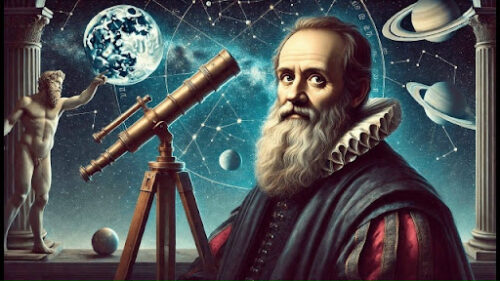
It all started with one pipe
By this time, Galileo had already been teaching mathematics in Padua for several years.
And then he heard a rumor about a new Dutch device - some kind of tube through which distant objects appeared closer.
Galileo did not think long.
He figured out how this principle worked and made his own device.
And much better.
By August 1609, his telescope was already magnifying approximately eight times.
And then Galileo created an even more powerful instrument.
Venice saw the benefits first
Now imagine Venice in the 17th century. Campanile San Marco. Above is Galileo. Below is the Doge, the nobility, and officials.
And Galileo points his telescope somewhere toward the lagoon. And shows something that no one can see with the naked eye.
Ships.
Moreover, these were ships that were only just approaching Venice. For a city that lived by trade and the sea, this was far from just a curious optical marvel.
It was very useful technology.
For Venice, seeing a ship before it could be seen with the naked eye was practically a matter of national security. And Venice appreciated the invention.
Galileo donated his telescope to the Republic, and in return received a lifetime position at the University of Padua and a significant increase in salary - up to 1000 florins per year.
But the most interesting thing started later.
Because Galileo decided to look through this tube not only on ships.
He looked at the sky.
And the sky turned out to be completely different
What Galileo saw turned out to be far more important than the opportunity to spot the ship before his competitor.
The Moon was not a perfect, smooth celestial ball.
There were mountains and depressions on it.
The Milky Way turned out to contain a huge number of stars that were simply invisible to the human eye. And around Jupiter, Galileo discovered four small bodies orbiting it.
Today we know them as: Io. Europe. Ganymede. Callisto.
Galileo named them "Medicean stars" - in honor of the Medici family.
And here something much more than just a scientific discovery happened.
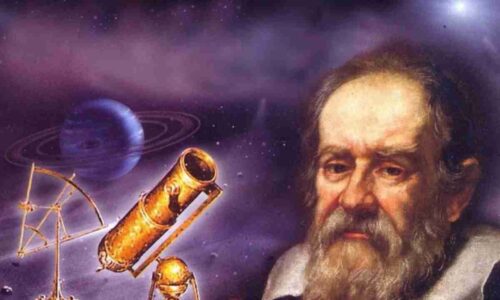
If everything doesn't revolve around the Earth...
If other celestial bodies can move around Jupiter, then The Earth is not necessarily the only center of motion of the entire cosmos.And if the surface of the Moon is similar to the surface of the Earth, then perhaps the boundary between the "heavenly" and "terrestrial" worlds is not as obvious as was thought for centuries.
Galileo actually told people: See for yourself. Just don't believe what is written in old books.
Take a look.
And it was much more dangerous than just a new telescope.
Because the telescope changed not only that, what the man saw.
He changed that, how man understood his place in the Universe.
Starry Messenger
In March 1610 The famous one was released in Venice Sidereus Nuncius — Starry MessengerThe first print run was about 550 copies, and they separated almost immediately.
Europe received a description of a new world—a world that had previously existed literally beyond human vision. And I especially like one detail in this whole story.
Venice first saw practical benefits in Galileo's invention.
How to spot a ship early. How to gain an advantage. How to use new technology for trade and security.
And Galileo himself very soon used the same instrument to show man a completely different world.
From ships to the stars
And if today you climb up the Campanile di San Marco and look at the lagoon, you can try to imagine that moment.
1609.
Below is Venice.
City of trade, ships and money.
And at the top is a man with a small pipe, which for the first time allows the human eye to see much further than the usual horizon.
First, the ships.
Then - the Moon.
Then - Jupiter.
And suddenly it turns out that the familiar picture of the world no longer works.
This is probably why the story of Galileo in Venice is not only the story of science.
This is a story about look.
That sometimes it’s enough to take a familiar thing and look at it a little differently.
And then it no longer remains familiar Nothing.