The Little Book That Actually Changed All of Europe
15.09.2026
How Giordano Bruno was betrayed in Venice
15.09.2026
How Verrocchio came to Venice – and left her Colleoni
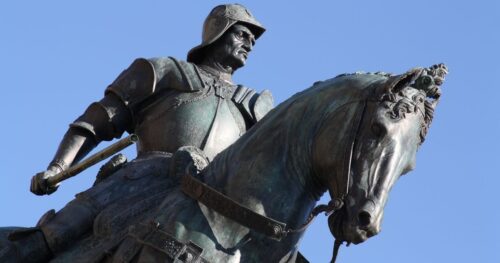
If you find yourself on Campo Santi Giovanni e Paolo, be sure to stop in front of the monument to Bartolomeo Colleoni.
Just don't look at it as just another monument.
Because before you is one of those cases when the sculptor decided to show more than just a man on a horse.
He decided to show his power.
From Florence to Venice
Verrocchio came to Venice from Florence. By then, he was already a renowned artist and sculptor. He worked for the Medici, painting, sculpting, and making jewelry. And yes, it was in his Florentine workshop that the young Leonardo da VinciBut the Venetians didn't invite Verrocchio to paint them a picture. He was commissioned to create a monument to a man the Venetians knew very well— Bartolomeo Colleoni. Condottiere. A military leader who served the Venetian Republic and left it a vast fortune.
Colleoni bequeathed money to Venice - with one condition: A monument was supposed to be erected to him.
Venice agreed.
But, as is often the case in Venice, in my own way.
A monument that became larger than a portrait
Colleoni wanted his monument to be in St. Mark's Square. Venice decided otherwise. It was erected in front of the church. Santi Giovanni e PaoloAnd this is where the fun begins.
Look at Colleoni. He's not just sitting on a horse. It's as if he's about to move forward. The horse is tense. Its neck is stretched out. One leg is thrust forward. And Colleoni's face looks nothing like the face of a man humbly posing for a posthumous portrait.
There's tension in it. Confidence. And the feeling of a man accustomed to giving orders. And that's very accurate. Because Verrocchio wasn't just creating a depiction of a dead condottiere.
He created an image of strength.
After Donatello
At that time, the equestrian monument was already a serious artistic challenge. Verrocchio was faced with the famous Gattamelata Donatello in Padua.
But Verrocchio went further. His Colleoni doesn't just stand there. He's moving. It seems that in another second this heavy bronze figure and its horse will tear off.
And that is why the monument makes such a strong impression even today.
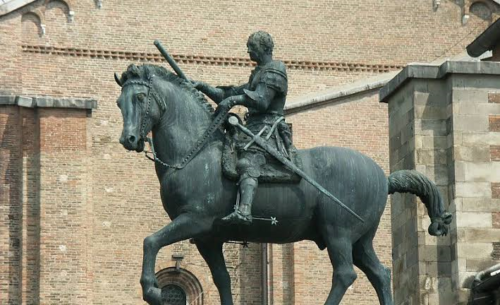
Verrocchio never saw him again.
There is also a bit of sad irony in this story.
Verrocchio died in 1488.
And the monument was erected after his death - in In 1496.
It turns out that the sculptor never saw his Colleoni in Venice as we see him today.
But he managed to do the main thing.
He created a man who continues to look as if he is about to speak and give an order.
And now - a small detail
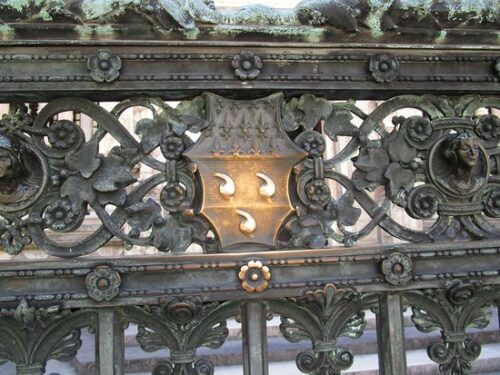
Now look at Colleoni coat of armsYes, you saw it correctly. It really is three images of testicles.
And here begins a story that is best told without unnecessary embellishment, because it is quite good on its own. 🙂
Three testicles were part of the Colleoni family coat of arms. In fact, Bartolomeo Colleoni himself described his coat of arms in exactly this way in a 15th-century document.
But why exactly three?
There is an old legend that the condottiere himself had a rare anatomical feature - three testicles, and it was from here that his coat of arms allegedly came.
There is no evidence for this.
That is why historians regard this version as legend, and not as an established fact.
But there is a curious coincidence.
Surname Colleoni related to Latin coleus — “testicle”, and in the documents of the 15th century the form is also found Coglioni.
So the story here turns out to be almost a ready-made joke, invented by the era itself.
And yet, the most interesting thing is not this
Because if we move away from this funny detail, we are left with an absolutely amazing story.
The condottiere leaves Venice a huge fortune.
Venice erects a monument to him - but not where he asked.
The Florentine sculptor created for him one of the greatest equestrian monuments of the Renaissance.
And more than five hundred years later we still stand before it and try to understand:
What exactly did Verrocchio want to say with this man?
The answer is probably quite simple.
He wanted to show a force that needs no explanation.
And he succeeded.
And three testicles?
This is already a small Venetian detail that reminds:
Behind great monuments there are sometimes very human stories.
And perhaps that's why in Venice you should never look at a monument from just one side. 😄